Project timeline
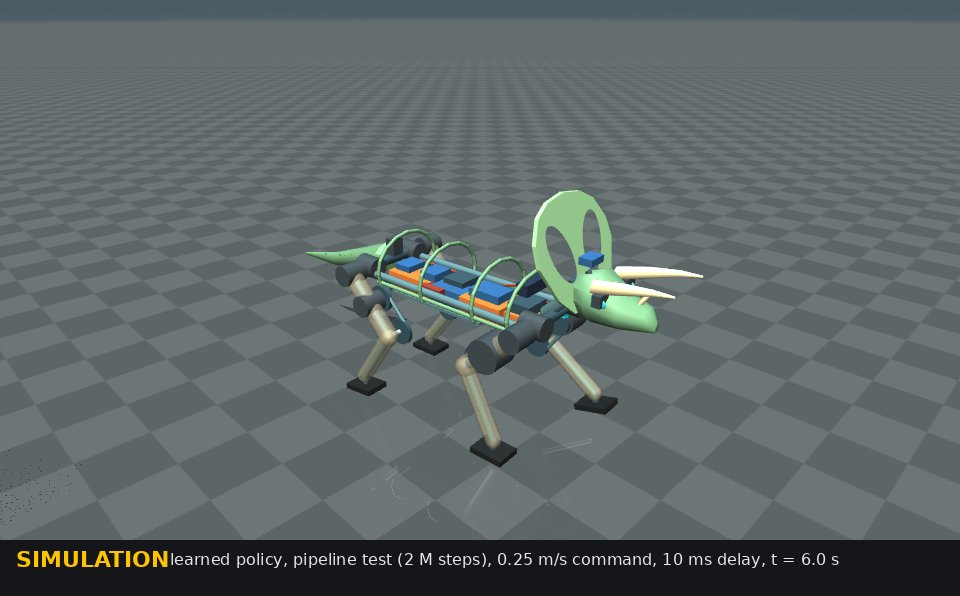
The lab has tested its 60 cm Triceratops in simulation. Before building all four legs, the next step is to measure how one physical foreleg responds under load.
Recorded milestones
Project launch
The lab opens with simulated animals
Mesozoic Labs introduced an open-source project to explore how dinosaur-inspired bodies move. Articulated models in MuJoCo gave the lab a place to train and test controllers.
Read the launch announcementSimulation study
What counts as standing?
A trained T. rex spread its feet at the start and leaned on one leg. Comparing its foot placement with a motionless reference showed how it had passed the earlier balance test.
See the balance studyDesign decision
Triceratops becomes the first planned build
The lab chose a four-legged robot for its first hardware demonstration. A Triceratops can keep three feet down during a slow walk. The two-legged T. rex study was paused for a later build.
Read the build decisionSimulation result
Forty flat-floor trials
The 60 cm Triceratops completed ten trials in each of four simulated floor conditions. It stayed upright in all forty. A separate test on a 5° ramp reduced its speed by 27%.
See the walking trial results
Hardware plans
- Next
Planned bench test
Measure one Triceratops foreleg
A single-leg test rig would let the lab measure turning force, speed, heat and the delay between a command and the motor’s response. Those measurements can be checked against the simulation before assembling four legs.
Read the planned bench purchases - Q3 2027
Hardware target
Walk the 60 cm Triceratops
The goal for July through September 2027 is to assemble the four-legged robot and demonstrate a physical walk. The current design measures 1.2 m overall.
See the 60 cm design to scale Hardware target
Build and test the 75 cm T. rex
The biped adds a balance challenge at every step. Its retained simulation studies include tests of how motor response time affects its ability to stay upright.
Explore the T. rex study and restart plan